Guides
August 14, 2026
Can You Polish an Existing Concrete Slab?
Usually yes, including slabs under carpet, tiles or years of paint. Here's what actually decides whether your floor can be polished, and what happens if it can't.

Usually yes, including slabs under carpet, tiles or years of paint. Here's what actually decides whether your floor can be polished, and what happens if it can't.
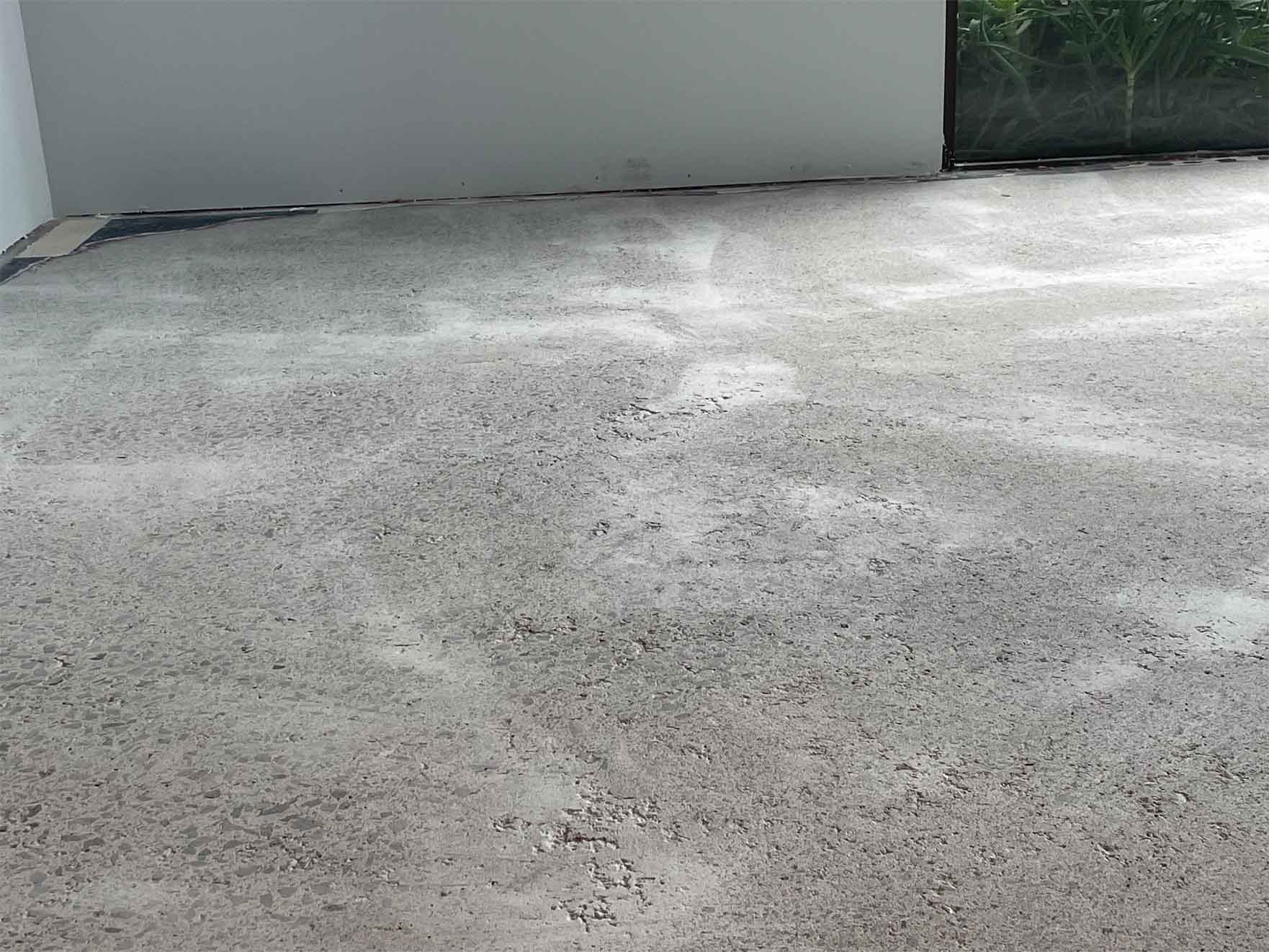
The short answer: usually, yes. Most existing concrete slabs can be polished, including ones currently hiding under carpet, tiles, vinyl or old paint. Age isn't the deciding factor, and plenty of older slabs polish beautifully. What actually decides it is how hard and sound the concrete is, and that can only really be judged on site. If your slab isn't up to a full polish, a grind and seal usually delivers a very similar look without the risk.
It's the question we get asked more than any other, usually by someone standing in a room they're about to renovate, wondering whether the floor under their carpet is worth uncovering.
Here's how to think about it.
There's a common assumption that polishing is for new slabs and older concrete is past it. It isn't true, and in some ways the opposite is closer to the mark.
Older slabs often have aggregate in them that newer concrete doesn't, and decades of settling means the stone sits differently. When you grind into a forty year old slab you sometimes find something a new pour simply can't replicate. We've polished floors in houses older than the people living in them, and they've come up better than the new builds down the road.
What matters isn't when the concrete was poured. It's what condition it's in now.
How hard the concrete is. This is the big one. Polishing works by grinding into the surface and then refining it through progressively finer stages. Concrete that's too soft won't hold that finish, and pushing it can do more harm than good. Hardness varies with the original mix, how it was placed and finished, and how it has aged.
Whether the surface is sound. A slab with a weak, dusty or sandy top layer has a problem that grinding may or may not solve. Sometimes the weak layer is thin and there's good concrete underneath. Sometimes it goes deeper. You find out by grinding a test patch, not by guessing.
How flat it is. Concrete doesn't have to be perfectly flat to be polished, and grinding takes high spots off as it goes. But a floor with significant dips and hollows may need levelling work first, or may end up with an uneven exposure across the surface, where some areas show more stone than others.
What's on it now. Carpet glue, tile adhesive, old epoxy, paint, sealers and levelling compound all have to come off completely before polishing. That's normal work and it's a big part of what we do, but it affects both the price and the timeline.
What's in it. Old repairs, patches, embedded trunking, holes from removed fixings and previous crack fills all become visible once a floor is ground. Some of that adds character. Some of it needs dealing with first.
None of this replaces someone looking at it properly, but a few things are worth knowing before you call anyone.
Scratch it. Find an out-of-the-way spot and run a screwdriver or a key across the surface with some pressure. Hard, sound concrete resists it. If it gouges easily or produces a pile of powder, the surface is soft, and that's worth mentioning when you get in touch.
Look at the edges. Where carpet meets a doorway or a section of flooring has lifted, you can often see the bare slab. It won't tell you much about the aggregate, since that's below the surface, but it will tell you about condition.
Check for damp. Tape a square of plastic down tightly for a day or two. Moisture underneath suggests the slab is holding water, which matters more for coatings than for polishing, but it's worth knowing.
Don't judge by how it looks. A stained, marked, ugly slab is not the same thing as a bad slab. Most of what you're looking at is on the surface, and the surface is what comes off first.
This is the most common version of the question, and the answer is usually encouraging.
Under carpet you'll typically find adhesive residue, tack strip marks around the perimeter, and the holes and marks those leave behind. All of it grinds off. The tack strip line is the bit people worry about, and it's rarely a problem once the floor is ground and the holes are filled.
Under tiles you'll find mortar or adhesive, usually in ridges. It takes more grinding than carpet glue but it comes off. Occasionally tiles leave shadowing in the concrete itself, which may still be faintly visible after polishing. We'll tell you if that's a risk on your floor.
Under vinyl you'll find adhesive, sometimes a lot of it, and on older floors sometimes a layer of levelling compound as well. Compound has to come off entirely, because it isn't concrete and it won't polish.
In all three cases, the work of removing what's there is floor preparation, and it's usually quoted as part of the job.
Sometimes a slab isn't up to it, and we'd rather say so than take the job and hope. When that happens there are good options.
Grind and seal. The floor is ground back the same way, exposing the stone, but instead of continuing through the fine polishing stages we protect it with a quality sealer. It's more forgiving of a softer slab, it costs less, it's quicker, and to most eyes the finished floor looks very similar. For a lot of the floors we're asked about, this is the honest recommendation. More on grind and seal here.
Repair first, then polish. Where the problem is localised damage rather than the slab overall, repairing it before polishing is often straightforward. Cracks, holes and broken sections can be cut back and rebuilt.
Grind it flat for something else. If the slab won't take a finish but you want the floor level and clean for new flooring going over it, that's a preparation job rather than a polishing one.
Epoxy. For garages and workshops where the slab is sound but unremarkable, a coating gives you a hard-wearing, easy-clean floor without relying on what's inside the concrete.
Two things worth being straight about.
First, how much stone shows isn't entirely a choice. Where the aggregate sits in your slab and how evenly it was placed sets the ceiling. We can grind deeper to expose more, but only to the point the concrete allows. A floor where the stone sits deep may not reach a full exposure at all, and no contractor can change that.
Second, an existing slab carries its history. Old repairs, colour variation, joints and previous damage often remain visible in the finished floor. Most people find that adds character, and it's part of what makes a polished floor one of a kind. But it's better to know that going in.
Someone has to look at it. Concrete can't be assessed honestly from a photo, because the things that decide it, hardness and soundness, aren't visible in an image.
Our free on-site assessment takes about half an hour. Jay checks the slab, tells you what it can realistically become, and gives you a fixed price for whichever service actually suits it. If the answer is that your floor won't polish, you'll hear that too, along with what will work instead.
There's no cost in finding out, and most people are surprised by what's under their carpet.
Thinking about uncovering your slab?
Jay will come and look at it, tell you honestly what it can become, and give you a fixed price. No obligation and no call centre.
Jay will come and look at it, tell you honestly which service it needs, and give you a fixed price. No obligation and no call centre.