Fixes
September 30, 2026
How Do You Repair a Concrete Floor Damaged by Forklifts or Trucks?
How concrete floors damaged by forklifts or trucks are repaired: cutting out the broken section and rebuilding it with an epoxy mortar.
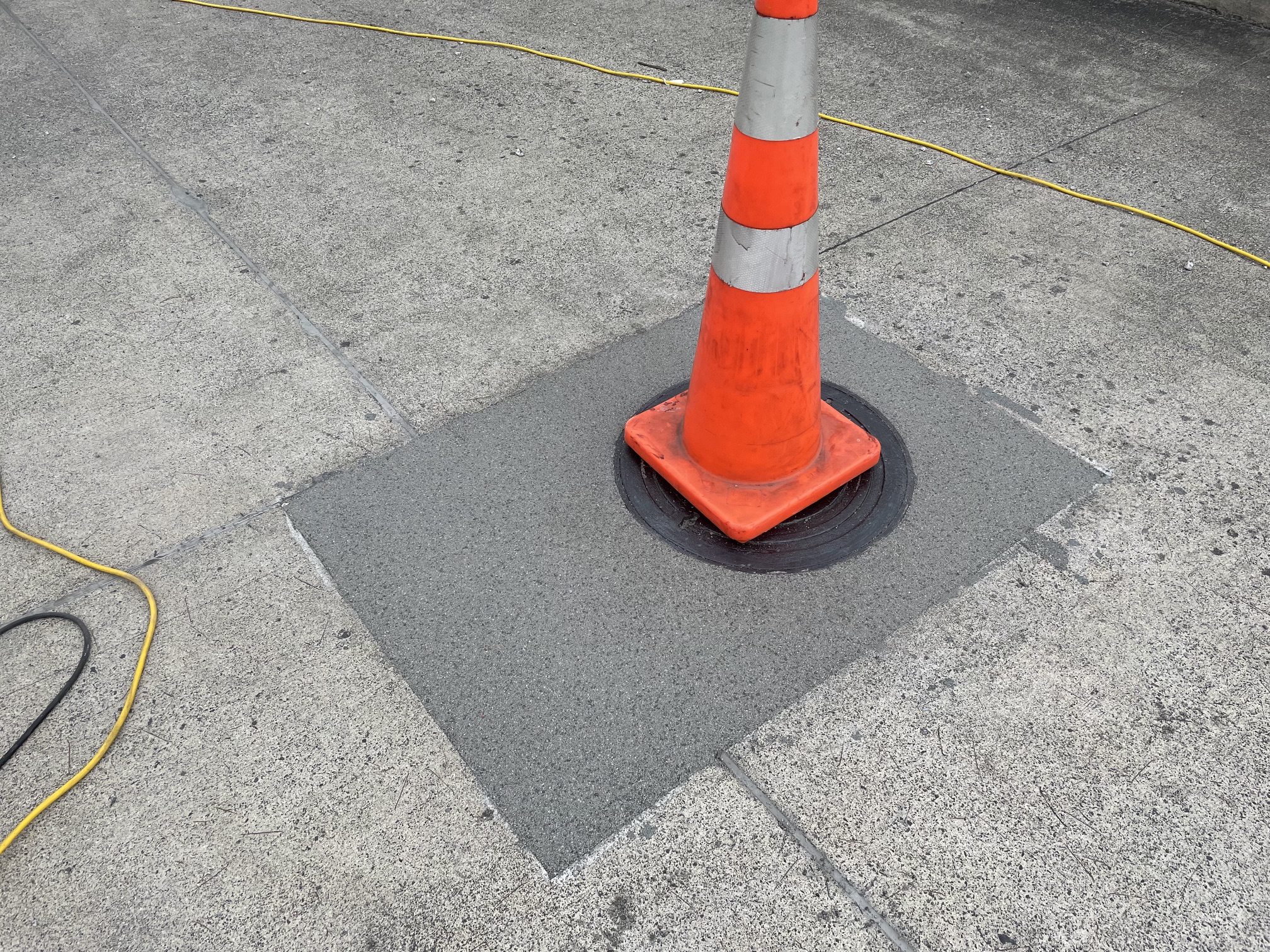

How concrete floors damaged by forklifts or trucks are repaired: cutting out the broken section and rebuilding it with an epoxy mortar.
A concrete floor damaged by forklifts or trucks is usually repaired by cutting out the broken or crumbling concrete back to sound material, then filling the area with an epoxy repair mortar that bonds to the cut edges and cures hard. This works well for a damaged patch or a run of damage along a route. It is not a fix for a slab that is failing throughout, which needs a different look altogether.
A forklift or truck wheel puts a sharp, repeated load on a small area. Over time that shows up as cracking, crumbling or flaking at slab edges and joints, and potholes where the top layer has been punched right through. It tends to happen fastest where the slab was already weaker, such as a thin edge, a poorly formed joint, or a section where the top layer is soft.
Crumbling concrete does not give a repair anything solid to bond to. If a patch goes straight over loose or cracked material, it moves with that material and fails again, usually faster than the first time. Cutting back to sound, solid concrete first gives a clean edge for the new material to key into.
Once the damaged area is cut out and cleaned of dust and loose material, it is filled with an epoxy repair mortar, a mix of epoxy resin and graded sand. It bonds strongly to the cut edges and cures into a hard, dense patch. It is finished level with the surrounding floor and can be ground smooth to match.
Removing and repouring a section of slab means formwork, curing time, and an area out of action for longer. An epoxy repair is a targeted fix for a damaged section, done in place, without the same shutdown. We do not pour new slabs, which is exactly why we can give you an honest read on whether a patch repair is enough or whether the area needs a different approach.
Possibly, if the cause has not changed. If forklifts keep hitting the same edge at the same angle, that edge will wear again eventually. Where damage keeps recurring in one spot, it is worth looking at the route, the load, or whether that edge needs more protection, not just repairing it the same way each time.
An epoxy repair fixes a defined damaged section. It does not fix a slab that is cracking or sinking throughout, or one with a structural problem underneath. If the damage is widespread rather than localised, that needs a proper assessment before anyone talks about a repair method. For cracked or damaged floors generally, see our Concrete Repair page.
Our on-site assessment is free with no obligation. In Auckland, you get a written fixed quote within 24 hours of the site visit. Call Jay at Concrete Grind Pro on 021 061 2597, or Talk to Us About Your Site
Jay will come and look at it, tell you honestly which service it needs, and give you a fixed price. No obligation and no call centre.